THE EQUIPMENT NOTEBOOK · BUYING GUIDE
What makes a coffee machine worth thousands?
Often, you are paying for control, consistency and a morning routine that works for you. The value depends on which of those you actually need.
Researched 11 October 2026 · Home espresso, not commercial café equipment
You do not need a costly machine to make good coffee. For someone who enjoys filter coffee, a simple brewer may be the better purchase. Espresso puts different demands on the equipment, and expensive machines solve different problems. Identify the part of your current routine you want to improve before comparing price tags.
1. More control over the brew
Temperature control helps make results repeatable. A PID controller adjusts heating to keep a target temperature; some machines also let you change that target. Pre-infusion wets the coffee before full brewing pressure, and timed or volumetric controls help repeat a recipe. These tools make experimentation easier, but the beans, grind, dose and preparation still matter.
These features are not exclusive to luxury machines. The Barista Express already has PID control and pre-infusion. A higher price needs to buy something beyond a feature you already have.
2. Less waiting between coffee and milk
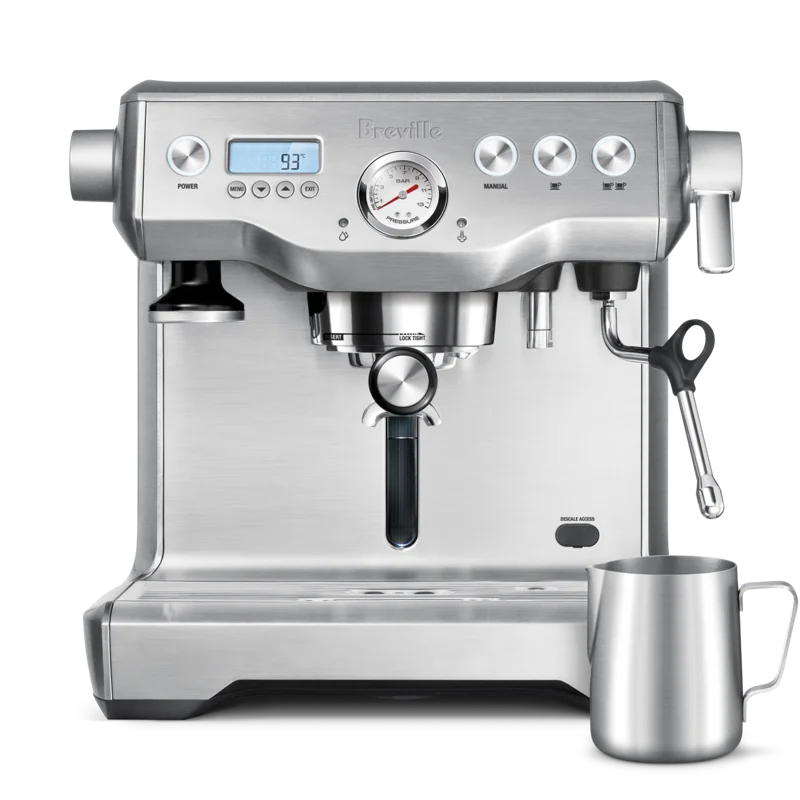
A basic single-boiler design uses the same boiler for brewing and steaming at different temperatures, so the sequence involves waiting. A true dual-boiler machine separates those jobs. The Breville Dual Boiler can brew and steam together—useful for someone confidently making several cappuccinos.
Fast-heating systems are another approach. The Oracle Jet uses ThermoJet heating and queues milk after extraction. It is a premium machine, but it is not a simultaneous-brewing dual boiler. Compare the actual workflow rather than assuming every expensive machine behaves alike.
3. Assistance, or full automation
An assisted portafilter machine reduces some manual jobs. The Barista Touch Impress provides dosing guidance, assisted tamping and automatic milk texturing. The Oracle Jet goes further with automatic grinding, dosing and tamping. You still handle the portafilter.
A bean-to-cup machine such as the JURA E8 brews internally and prepares programmed milk drinks. That convenience may be valuable every day, but it offers a different experience from learning puck preparation and manually steaming milk. Automatic does not mean maintenance-free.
4. A better fit for a busy household
Saved preferences, clear controls and straightforward cleaning can matter more than a long feature list. The Rivelia offers interchangeable bean hoppers and an automatic hot-milk carafe. Check how changing beans works, whether the carafe fits your fridge and whether everyone will follow the cleaning routine.
Do not assume every accessory in a lifestyle photo is included. Cold-milk kits, milk coolers, connectivity accessories and grinders can be separate purchases.
5. Ownership, not just the checkout price
Consider counter depth, overhead clearance for filling beans and water, drip-tray access, noise, warm-up habits and the location of a repair service. Stainless steel styling alone does not establish durability. Read the exact model’s manual and warranty, and check whether your chosen Amazon seller qualifies for manufacturer support.
Build a realistic budget
Machine + grinder if needed + useful accessories + coffee and milk + filters and cleaning products + electricity + servicing.
For illustration only: a $2,000 setup used for two drinks every day for five years spreads its purchase cost across about 3,650 drinks—roughly $0.55 per drink before ingredients, maintenance, energy or repairs. This assumes it lasts and you keep using it; it is not a savings promise.
What does not justify a premium by itself?
- A bigger pump-pressure number. Maximum pump pressure is not a taste rating. Breville, for example, describes 9-bar extraction from a 15-bar pump.
- A large touchscreen. Useful guidance can help; a display alone cannot improve stale beans or unsuitable grinding.
- Dozens of drink names. Check the drinks you actually use and how much you can customise them.
- A best-seller badge. Sales popularity helps identify models to investigate. It does not prove that a machine suits your needs or will last longer.
Our buying rule
If you love learning espresso, prioritise grinding, repeatable brewing and the milk workflow. If you love the drink but not the preparation, prioritise automation and easy upkeep. If you make one ordinary coffee each morning, explore a simpler brewer before spending thousands.
Pre-purchase checklist
- Choose hands-on, assisted or fully automatic preparation.
- Count the drinks you make in one sitting.
- Include a suitable grinder in the budget where required.
- Measure your counter and filling clearance.
- Check the exact US model, voltage, seller and warranty.
- Read the milk-cleaning and water-treatment instructions.
- Check replacement-part and local service options.
- Compare current price and return terms; avoid unnecessary accessory bundles.
This is a researched buying guide, not a hands-on product test. Suitability judgements are our interpretation of the linked manufacturer information. Specifications and packages can change.